Halter Sports Bras: Support, Neckline Stability and Strap Engineering
Halter Sports Bras: Support, Neckline Stability and Strap Engineering
The halter programme currently published by Gymshark is a seamless CottonMove halterneck sports bra built from 77% cotton, 14% nylon, 8% elastane and 1% polypropylene, listed as light support with a curved underbust, a low coverage neckline and a halter neck. Bo+Tee's Soft Active Reversible Sports Bra takes the same neckline family along a different route: a double-layered plunge halterneck in 80% polyester and 20% elastane, positioned as low-impact and reversible, with four-way stretch and a buttery soft handfeel. Two different constructions, one shared neckline logic. HUCAI Gymwear, engineered by HUCAI Sportswear, develops halter bras for studio, Pilates and light-training ranges, and the first engineering question is never how the neckline reads on a flat sketch. It is where the load lands once the garment is worn, moving, and under tension.
Two published product pages sit behind this guide. Gymshark lists its halterneck bra as seamless and breathable in a cotton-blend knit, with light support, a curved underbust seam and a low coverage neckline. Bo+Tee lists its bra as double-layered with a plunge halterneck, low-impact support, four-way stretch and sweat-wicking fabric. The observation is consistent across both: the halter neckline is being merchandised as a studio and everyday silhouette rather than as a statement back-reveal piece, and the support language attached to it stays deliberately modest. For an emerging label, the neckline is therefore no longer the differentiator. The engineering underneath it is. That shifts the development conversation away from neckline styling and towards support grading, strap load paths and the stability of the neckline edge.
Set the support level before the neckline. Define the target impact level first, then fix neckline depth, underband depth and strap width against it. A halter holds best when the underband carries most of the load, the neckline edge is stabilised by a firm binding or a second layer, and the strap is widened wherever it crosses the neck. Approve the bra on a wear trial rather than a flat-fit review. Flexible MOQ from 100 pcs per style and colour keeps the first run testable.
Inside This Guide
- 1. Why halter is now a studio silhouette rather than a back reveal
- 2. Neckline stability: depth, coverage and cup placement
- 3. Strap engineering: width, tension and where the load lands
- 4. Underband construction: how support level is set below the cup
- 5. Seamless or cut-and-sew: where structural control actually sits
- 6. Decision check: matching support level to construction
- 7. Questions US, AUS and Canadian sourcing teams ask most
- 8. Closing summary
Who This Guide Is For
- DTC founders adding a bra to a matching set and unsure which support level to claim
- Pilates, barre and yoga studios commissioning a halter bra for member ranges
- Fitness creators and influencer brands extending a neckline signature into a bra programme
- Private label buyers replacing a one-off halter style with a repeatable support standard
It is not written for high-volume commodity sourcing, where a halter is cut from an existing block and shipped without a wear trial or a defined impact level.
Manufacturing Parameters Referenced in This Guide
- Flexible MOQ from 100 pcs per style and colour, mixed sizing XS to XL
- Sample development 7 to 10 working days, bulk production 20 to 25 working days
- 4-needle 6-thread flatlock stitching and bonded or bound neckline edges
- Pantone TPX and TCX colour matching with lab dips confirmed per fabric base
- AQL 2.5 inspection with key measurement, seam and recovery checks across the order
1. Why Halter Is Now a Studio Silhouette Rather Than a Back Reveal
The first signal is in the support language rather than the silhouette. Gymshark's published halterneck bra is described as light support in a seamless cotton-blend knit, with a curved underbust seam and a low coverage neckline. Bo+Tee's reversible bra is described as low-impact with a double-layered plunge halterneck. Neither brand positions the halter as a high-support training bra, and neither leans on its original association with open-back fashion styling. The neckline has moved into the studio and everyday category, and the support claim has moved down with it.
The observation that follows is that halter is now selected for what it does at the collarbone, not for what it exposes at the back. From HUCAI Sportswear's production standpoint, that repositioning changes the risk profile of the style. A bra sold as low impact is worn for longer sessions at lower intensity, so the failure modes shift from bounce control to sustained neck pressure, edge roll at the neckline and cup migration over long wear. The commercial consequence is that the design brief has to name the impact level before the neckline is drawn, because neckline depth, strap width and underband depth are all downstream of that single decision.
2. Neckline Stability: Depth, Coverage and Cup Placement
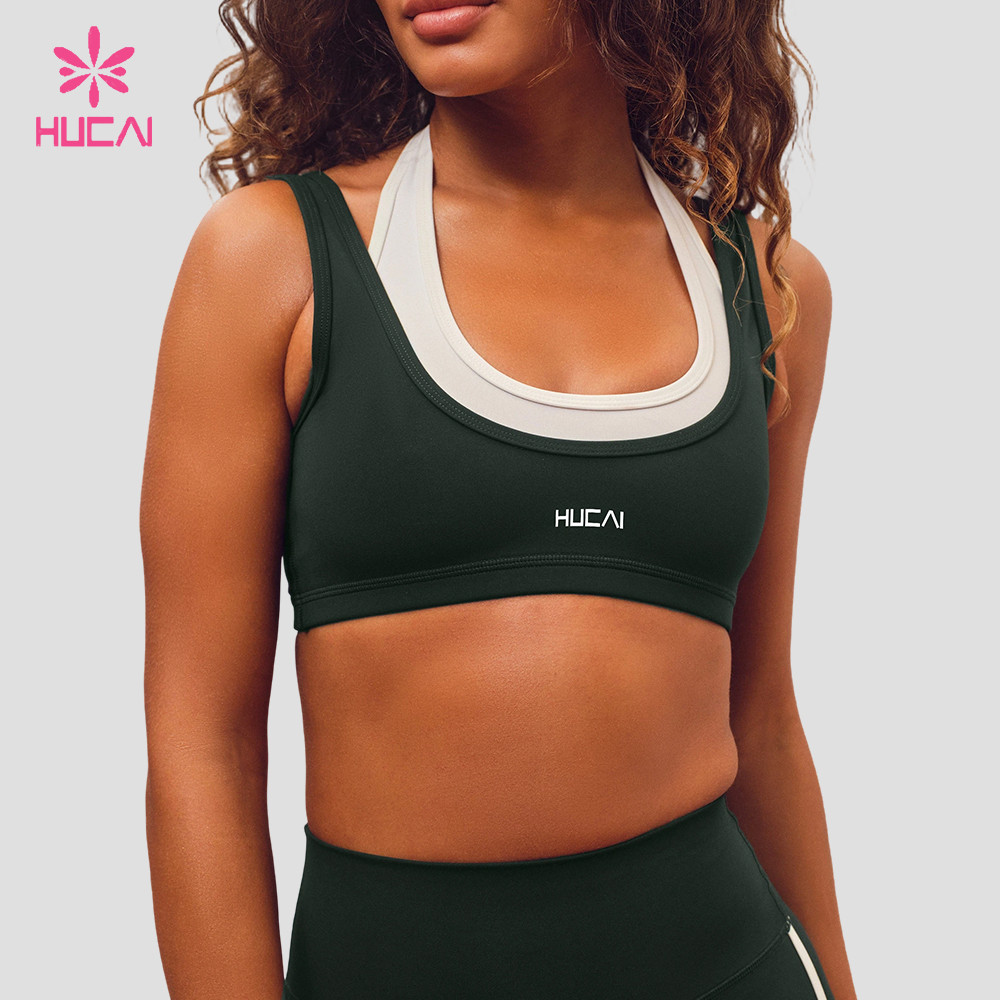
The second signal is that both published references describe a low coverage neckline as a deliberate feature. Gymshark pairs the low coverage neckline with a curved underbust seam, and Bo+Tee pairs a plunge halterneck with a double-layer construction. The neckline is shallow, the inner edge is exposed, and the underbust is carrying more of the structure than a straight square neck would need. That is a coherent design choice, and it is also where most emerging labels lose consistency between the sample and the production run.
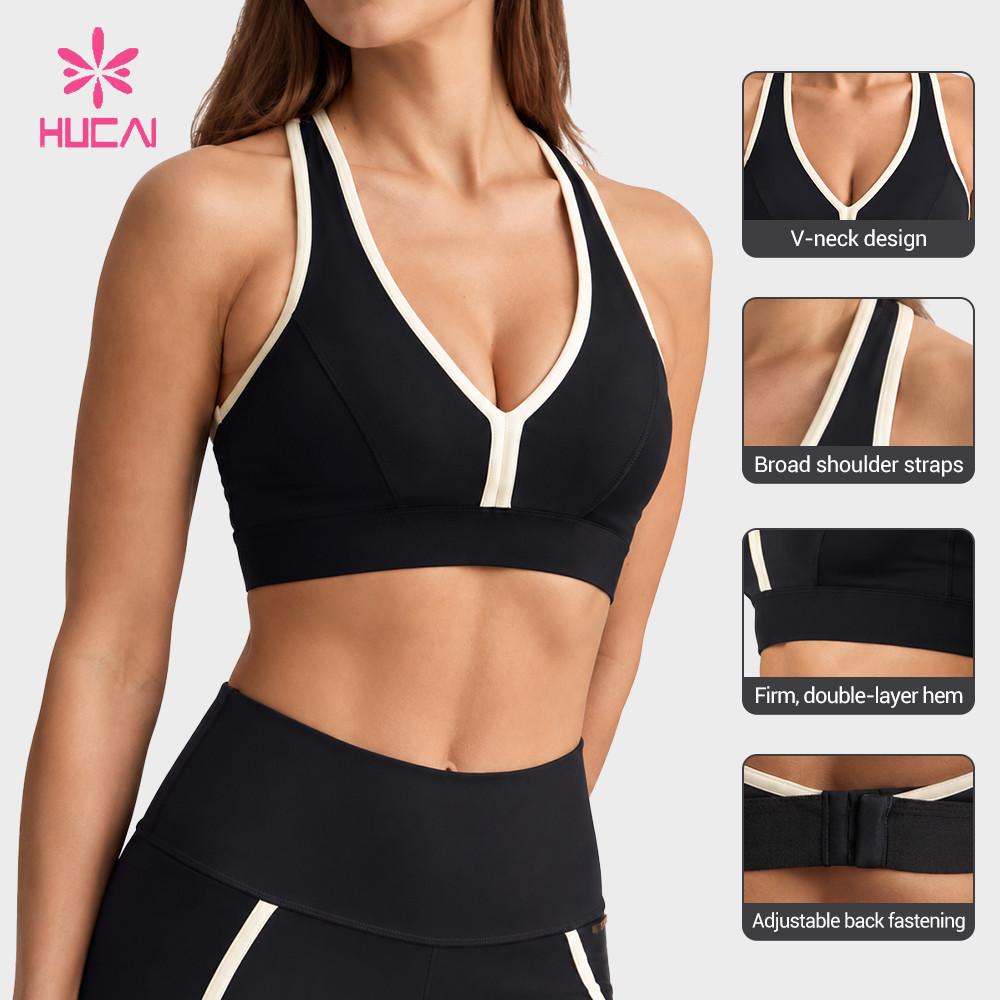
The observation is that a deep neckline is only stable when the neckline edge and the underbust seam are engineered as a pair. When the neckline edge is finished with a soft, low-tension binding, the edge relaxes outward during wear, the cup panel migrates downward, and the exposed inner layer starts to ripple along the front. At HUCAI Gymwear, neckline depth is therefore never approved on its own. The depth is fixed together with the tension of the neckline edge, the depth of the underbust seam and the position of the removable cup pocket, and the three are re-checked together on a wear trial rather than on a static fit form. The manufacturing recommendation is specific: specify the neckline edge as a bound or double-layered edge with a defined finished width, set the underbust seam to sit directly under the cup rather than at the rib line, and place the cup pocket so that the pad opening sits behind the underbust seam rather than at the neckline edge. A neckline that holds its depth under movement is what keeps a plunge halter reading as intentional at every size in the range.
3. Strap Engineering: Width, Tension and Where the Load Lands
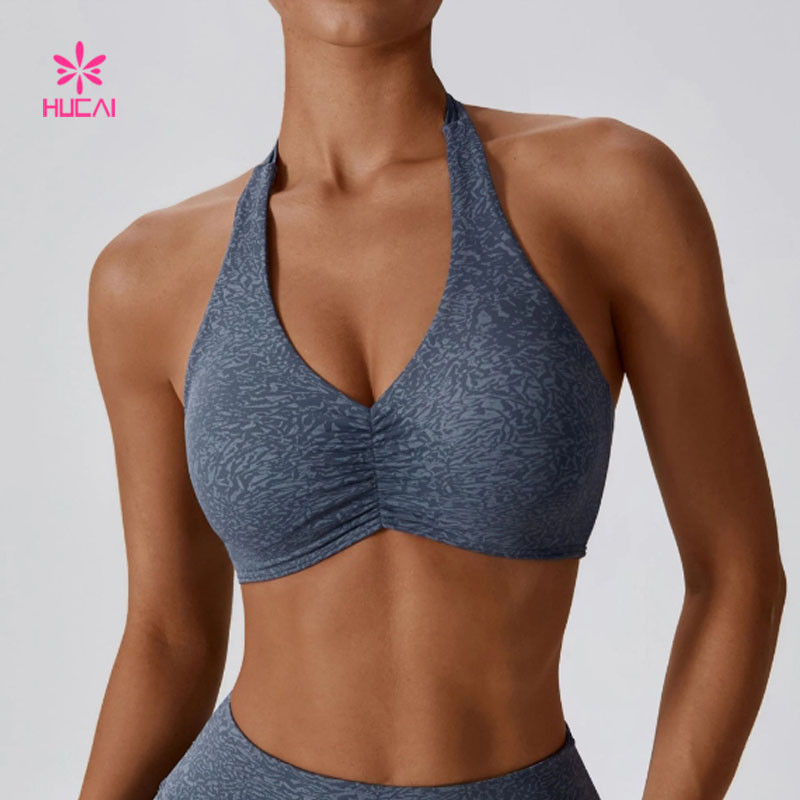
The third signal is that both references keep the strap deliberately broad where it approaches the neck. Gymshark describes a halter neck on a seamless knit, and Bo+Tee's reversible bra is double-layered with the same plunge halter neckline. Neither reference uses a thin string strap at the neck, and the reason is mechanical rather than aesthetic. A halter concentrates the entire upward load of the bra into two relatively short strap runs, and every millimetre of strap width removed at that point increases the pressure the wearer feels at the back of the neck.
The observation is that in a low-impact bra the strap is judged by sustained comfort rather than by bounce control, so the deciding variables are strap width at the neck, strap length tolerance and the recovery of the strap after repeated wear. Our strap development follows three rules. First, widen the strap along the section that crosses the neck, and take the width reduction further down towards the armhole where the strap is short and under less direct load. Second, set a length tolerance for the strap and check it on the smallest and largest sizes, because a strap that fits the middle of the size range can sit under tension on the largest size and feel slack on the smallest. Third, verify strap recovery after a wash cycle as well as on the wear trial, since a knit strap that relaxes is a support change the wearer feels immediately. A halter bra that is comfortable at the neck for a full studio session is a fit decision made at the pattern stage, not a trim decision made at the sample stage.
4. Underband Construction: How Support Level Is Set Below the Cup
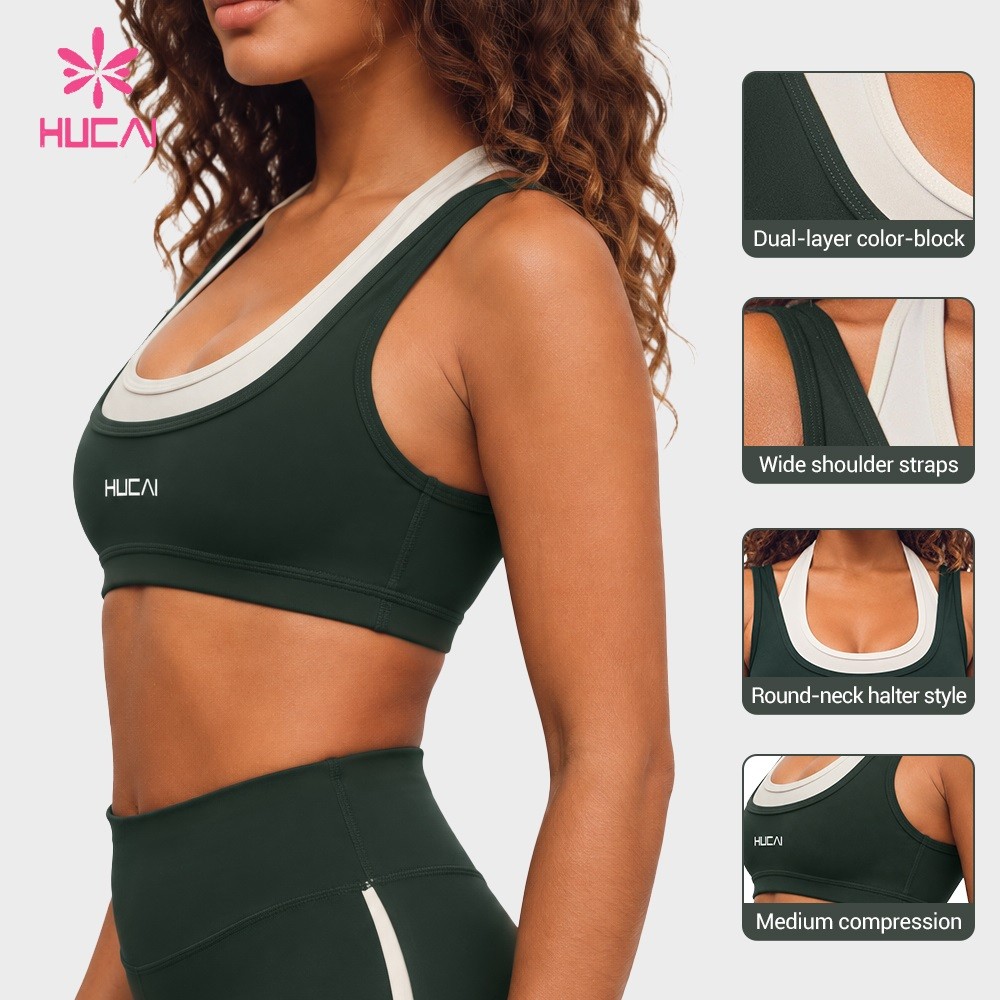
The fourth signal is that the underband is where both published references put their structure. Gymshark pairs the halter neckline with a curved underbust, and Bo+Tee builds the bra in two layers. In a halter the underband is doing more work than in a conventional bra, because the neckline carries almost no downward structure of its own and the strap tension is partly converted into downward pull along the front panel. Where a square-neck bra can rely on the neckline to distribute load, a halter has to place that load in the band.
The observation is that the underband, not the neckline, is what sets the support level a brand can honestly claim. Three variables decide it. Band depth below the cup determines how much of the load is absorbed before it reaches the strap. Band recovery determines whether the bra keeps holding after repeated wear. Strap-to-band load balance determines whether the wearer feels the support at the rib cage or at the neck. At HUCAI Gymwear, underband engineering for halter styles therefore starts with a band depth that is wide enough to hold under the cup, a recovery specification that is verified after wash testing, and a deliberate split of tension between the band and the strap. The manufacturing recommendation is to approve the band on a wear trial at the top of the size range, where the required hold is greatest, and to confirm that the band still returns to its original depth at the bottom of the size range rather than simply compressing. A halter that carries its support in the band can be sold as low impact without the neckline having to compensate for it.
5. Seamless or Cut-and-Sew: Where Structural Control Actually Sits
The final signal is that the two published references are built on different construction routes. Gymshark's halterneck bra is seamless in a cotton-blend knit, with the neckline and underbust shaped into the knit itself. Bo+Tee's bra is assembled from cut panels and then double-layered, which allows the inner layer to be a different colour and the edge to be finished independently. The two routes behave differently at the neckline, and the difference is not about quality. It is about where the structure can be adjusted.
The observation is that seamless gives a smoother edge but a narrower adjustment range, while cut-and-sew gives a wider adjustment range at the cost of an edge that has to be finished deliberately. In a seamless halter, neckline depth and edge tension are largely locked into the knit programme, so a change to either is a change to the knitting specification. In a cut-and-sew halter, the neckline edge can be bound, double-layered or bonded, and each choice changes both how the edge behaves and how the neckline reads. HUCAI Sportswear's recommendation for a first halter programme is to treat the edge finish as a graded decision rather than a fixed one: confirm the edge method in the sample round, verify it after wash testing, and record the finished edge width so a second production run does not change it silently. The same discipline applies to colour, because an exposed inner layer at the neckline and a matching legging are rarely the same fabric base, and the two need to be approved side by side rather than on separate lab dips.
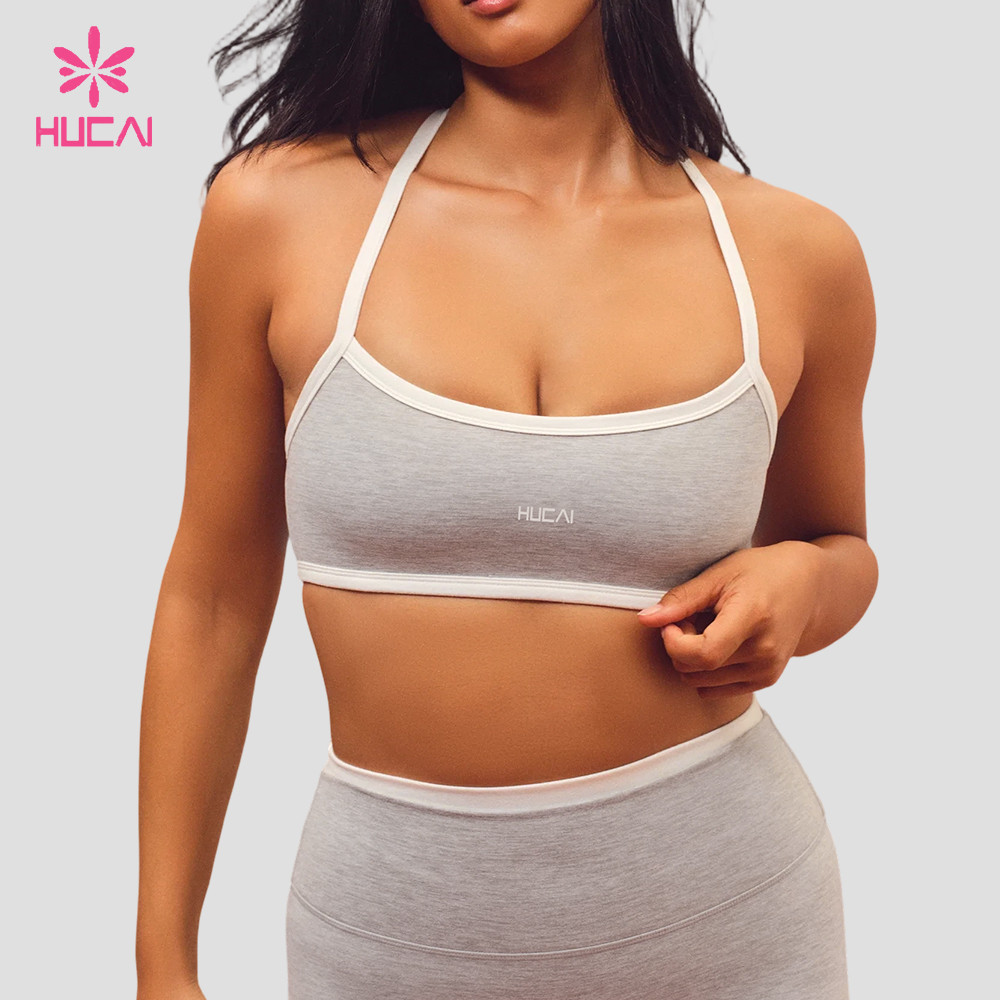
From Jean Yuan's product-development perspective, a halter bra fails for reasons that never appear on a neckline drawing. The straps and the neckline are two ends of the same load path, so a deeper neckline and a narrower strap cannot be adjusted independently once the band depth is fixed. The sequence that works is to settle the impact level, then the band, then the strap width at the neck, and only then the neckline depth, because a neckline approved last will always be approved against a structure that no longer matches it. In HUCAI's Dongguan sample room, halter styles are fitted on a wear trial at the top and bottom of the size range before the edge finish is locked, since the neckline edge behaves differently on the largest size where strap tension is highest.
6. Decision Check: Matching Support Level to Construction
Use the table below to decide which construction route a halter style needs, and which checks decide whether the declared support level can be sustained in production. The right-hand column is the step that most often separates a halter that holds from one that drifts after the first wash.
| Halter construction | Support level it suits | Load placed on the neckline | Verification step that decides the outcome |
|---|---|---|---|
| Seamless knit halter | Light to low impact | Low, because the edge is shaped into the knit | Neckline depth and edge tension confirmed in the knit specification |
| Cut-and-sew single-layer halter | Low impact | Moderate, and rising as the neckline gets deeper | Bound edge width and tension verified after wash testing |
| Double-layer or colour-block halter | Low to medium impact | Moderate, with the inner layer stabilising the front edge | Layer elongation matched and the exposed inner edge re-checked on a wear trial |
| Halter with an adjustable back closure | Low to medium impact | Higher at the neck, reduced at the underband | Strap length tolerance and band recovery checked at both ends of the size range |
7. Questions US, AUS and Canadian Sourcing Teams Ask Most
Can a plunge halter be sold as more than low impact?
Only if the support is carried by the band rather than the neckline. A deeper neckline reduces the area available to hold the cup, so the band has to be deeper, the closure more adjustable and the strap wider at the neck. Raising the declared impact level without changing those three variables moves the failure point to the wearer's neck instead of improving support.
Why does the neckline edge ripple after a wash?
Usually because the binding and the main panel have different elongation and recovery. When the edge is bound with a lower-stretch tape, the panel relaxes around it and the edge ripples along the front. The fix is to match the binding elongation to the panel and to verify recovery after a wash cycle rather than only on a pressed sample.
How wide should a halter strap be at the neck?
Wide enough that the strap does not concentrate pressure at the back of the neck under the load the bra is claiming to support. The practical approach is to keep the strap broad where it crosses the neck, taper it towards the armhole, and set a strap length tolerance that is checked at the smallest and largest sizes rather than at a base size.
Should a first bra programme be seamless or cut-and-sew?
Seamless gives a cleaner edge and fewer seam lines, but neckline depth and edge tension are locked into the knit programme. Cut-and-sew allows the neckline edge, the layer structure and the colour blocking to be adjusted in the sample round. For a first run where the neckline is still being tuned, cut-and-sew usually gives more room to correct the fit.
What is the minimum order for a custom halter bra?
Flexible MOQ starts at 100 pcs per style and colour with mixed sizing from XS to XL, and sample development is supported before the bulk commitment. That makes it practical to test two neckline depths or two edge finishes from one approved block without funding a full-size run across every option.
How long does development and production take?
Sample development runs 7 to 10 working days once the fabric is available, and bulk production runs 20 to 25 working days from pre-production sample approval and deposit receipt. Neckline and edge approval should be completed in the sample round so the bulk run is cut against a settled specification.
How is a bra checked before shipment?
AQL 2.5 inspection is applied, key measurements and seams are checked across the order, band depth and strap length are compared against the approved specification, and colour is confirmed against the approved lab dips for each fabric base used. Where a bra sits in a matching set, the bra and the bottom are reviewed as one colour decision.
Closing Summary
A halter bra is a structure decision before it is a neckline decision. Three steps carry most of the outcome. Define the impact level first, then set the band depth, strap width at the neck and neckline depth in that order, so the neckline is approved against a structure that matches it. Treat the neckline edge as a controlled specification with a recorded finished width and tension, and verify it after wash testing rather than on a pressed sample. Finally, re-check strap length tolerance, band recovery and cup pocket position at both ends of the size range, because a halter that holds at the middle of a size run can fail at the extremes. Product teams developing a studio or Pilates range can review current bra development in our sports bra range, extend the silhouette into matching sports tank tops, or compare the wider yoga and studio clothing direction. New bra developments are also listed in the new arrivals collection, and brands starting from a reference image can review our private label programme before the first sample round.
Dongguan Humen Hucai Garment Co., Ltd. Flexible MOQ from 100 pcs per style and colour. Sample development 7 to 10 working days. Bulk production 20 to 25 working days. AQL 2.5 inspection. Pantone TPX and TCX colour matching with lab dips confirmed per fabric base.


