
V-Contour Leggings: Pattern Engineering for Subtle Glute Shaping
V-Contour Leggings: Pattern Engineering for Subtle Glute Shaping
Current product pages show two different answers to the same request. LSKD's Fusion V-Contour Ultra High-Rise Full Length Legging documents a V-shaped back yoke used to shape the seat, an ultra high-rise fold-over waistband, no front seam, and a 74% recycled polyester / 26% elastane base. DFYNE's Dynamic Leggings | V-Back documents a mid-rise V-back waistband with a firm scrunch and glute contouring, offered in short, regular and tall lengths. HUCAI Gymwear, engineered by HUCAI Sportswear, reads both as pattern-engineering decisions rather than trim choices. The V is cut into the back panel, so its angle, the back-rise curve, the seat negative ease and the back-centre seam tension decide whether the garment sculpts subtly or pulls out of shape across a full size run.
Two documented product pages anchor this guide. LSKD's Fusion V-Contour Ultra High-Rise Full Length Legging states a V-shaped back yoke for seat curve, an ultra high-rise fold-over waistband, no front seam, and a 74% recycled polyester / 26% elastane composition. DFYNE's Dynamic Leggings | V-Back states a mid-rise V-back waistband, firm scrunch with glute contouring, and three leg lengths, positioned as a balance between sculpt and flexibility. The observation is that V-back and V-yoke are no longer a single idea. They have separated into two technical routes: a structural back yoke that shapes through panel geometry, and a V-back with scrunch that shapes through gathered tension. Both routes are settled on the pattern table, not in the colour card.
Engineer a subtle V-contour legging by treating the V as a structural panel, not a printed line. Set the back-waist angle and seat negative ease per size, hold the back-centre seam tension constant, and validate the V on a live fit body in both a relaxed and a stretched state. Development is normally planned at 100 pcs per style and colour.
Inside This Guide
- 1. Why a V-contour is a pattern problem before it is a silhouette
- 2. Two technical routes: structural back yoke versus V-back with scrunch
- 3. Where the V angle breaks down during grading
- 4. Scrunch tension and left-right symmetry
- 5. Validating the V under tension before bulk
- 6. Decision check: validation points by contour route
- 7. Questions US, AUS and Canadian sourcing teams ask most
Who This Guide Is For
- DTC founders adding a sculpting legging to an existing bottoms line
- Pilates, barre and yoga studios commissioning a fit-driven member capsule
- Fitness creators building a signature seat-contour silhouette
- Private label buyers moving a V-back style from reference sample to bulk
It is not written for high-volume commodity leggings sourcing, where a single basic block and a single fabric are already the operating assumption.
Manufacturing Parameters Referenced in This Guide
- Flexible MOQ from 100 pcs per style and colour, mixed sizing XS to XL
- Sample development 7 to 10 working days, bulk production 20 to 25 working days
- 4-needle 6-thread flatlock stitching on seat, gusset and centre-back seams
- Grade 4 to 5 squat-proof opacity testing applied to all bottoms
- AQL 2.5 inspection with 100 percent key measurement and seam checks
1. Why a V-Contour Is a Pattern Problem Before It Is a Silhouette
The documented Fusion V-Contour legging carries a V-shaped back yoke, an ultra high-rise fold-over waistband and no front seam on a 74% recycled polyester and 26% elastane base. Read as an observation, the V on that garment is not applied decoration on a finished block. It is the line where two back panels meet, which means it carries load. Because the style is ultra high-rise, the V and the waistband occupy the same stretch zone, so a decision about the V angle is also a decision about how far the waistband will roll, recover and stay put during wear.
From HUCAI Sportswear's development standpoint, the recurring failure is sequence. Brands specify the V visually, approve a flat sample, and only discover at the fitting stage that the shaping reads differently on a body in motion than it did on the table. The corrective approach is to fix four dimensions before the first sample is cut: the back-waist angle, the back-rise curve, the hip negative ease, and the back-centre seam tension. Change any one of them and the apparent depth of the V changes with it, which is why a V-contour bottom degrades faster in grading than a plain high-rise legging does.
2. Two Technical Routes: Structural Back Yoke Versus V-Back with Scrunch
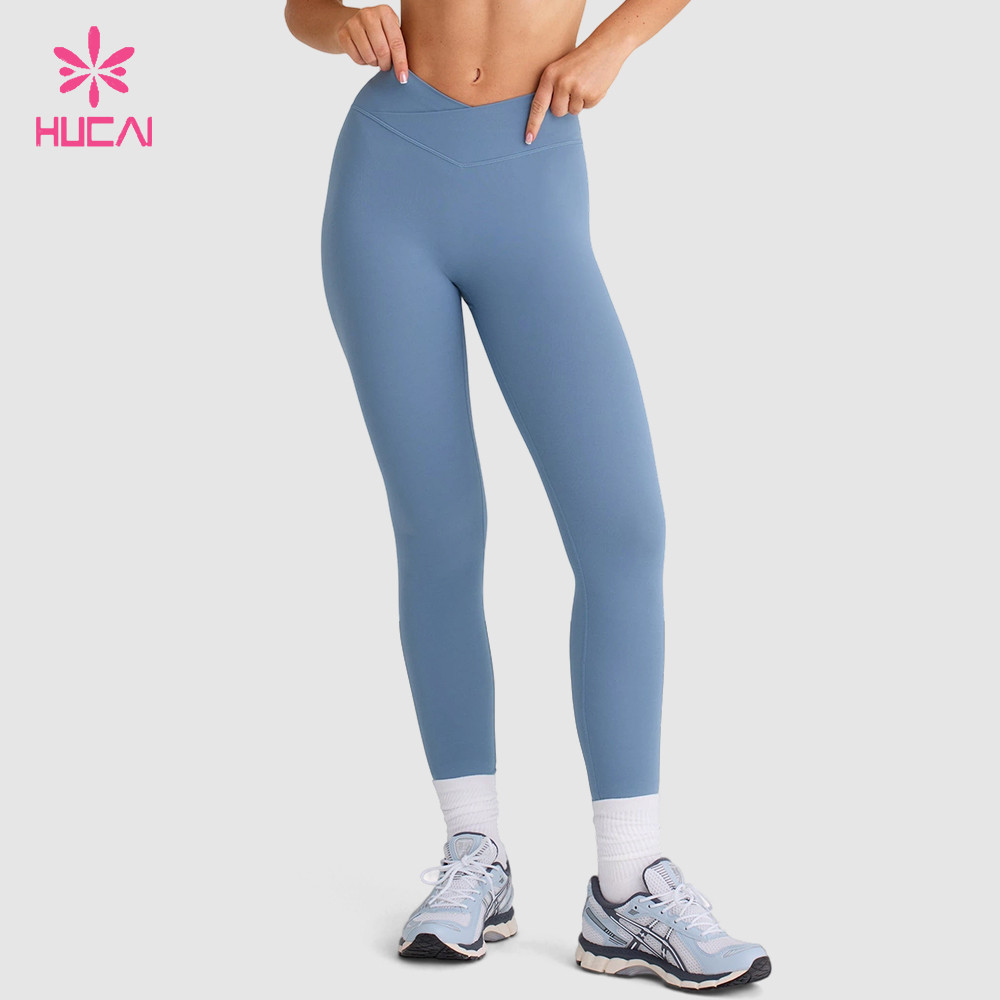
The two source pages describe genuinely different constructions. LSKD documents a V-shaped back yoke and a fold-over ultra high-rise waistband, which is a panel-geometry route: the seat curve is created by where the yoke seam sits and how the panel above it is shaped. DFYNE documents a mid-rise V-back waistband with a firm scrunch and glute contouring in three leg lengths, which is a tension route: the curve is created by gathering fabric along a centre-back zone and letting elastic recovery pull it into shape. The observation is that both routes are being sold to the same customer as the same benefit, but they demand different pattern checks.
HUCAI Gymwear develops both routes on the same base block so the difference is measurable rather than theoretical. On the structural route the critical measurements are the yoke seam position, the angle between the two back panels and the depth of the panel above the yoke, because the shaping is delivered by geometry and has to survive grading unchanged. On the scrunch route the critical figures are the length of the gathered zone, the amount of elastic recovery in the base fabric and the seam that anchors the gather, because the shaping is delivered by tension and disappears if the fabric relaxes. A brand that specifies a scrunch on a fabric developed for a structural yoke will generally lose the contour after the first wash cycle, not on the first wearing.
3. Where the V Angle Breaks Down During Grading
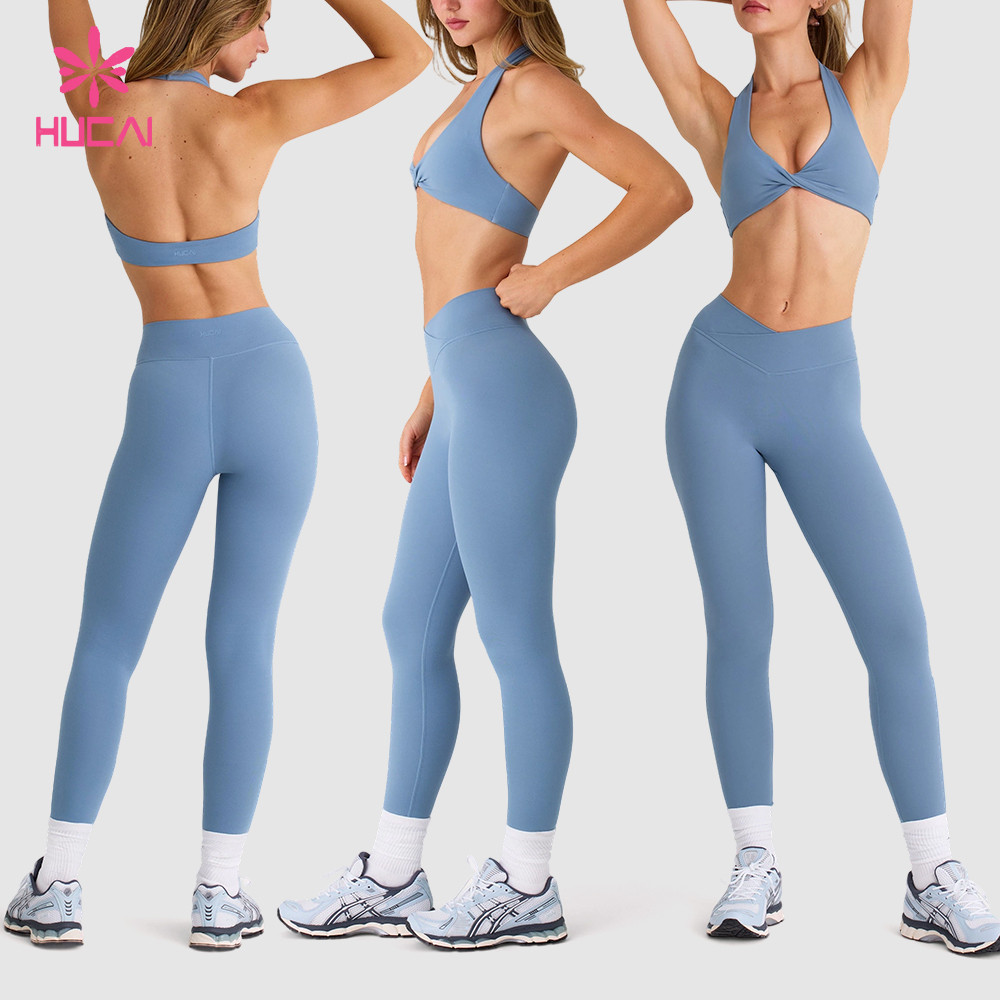
Grading is the least visible risk in a contour programme and the most expensive to correct after bulk. A V-back or V-yoke style carries an angled seam, and an angled seam does not scale in the same proportion as a vertical one. When the pattern is graded with a uniform increment, the V tends to flatten on the larger sizes and steepen on the smaller ones, so the same style number delivers two different silhouettes across an XS to XL range. The observation is straightforward: the consumer sees a size run as one product, while the factory sees it as five different pattern problems.
In practice this means the back-waist angle and the seat position have to be re-checked at each size rather than scaled from a single base. The two measurements that move first are the horizontal distance from centre back to the apex of the V, and the vertical distance from the waistband edge to the seat contour line. Both should be verified on the graded pattern, not only on the base size. The manufacturing recommendation is to treat grading as a separate approval step for any contour style, and to sign off the angle at the smallest and largest sizes before the middle sizes are confirmed.
4. Scrunch Tension and Left-Right Symmetry
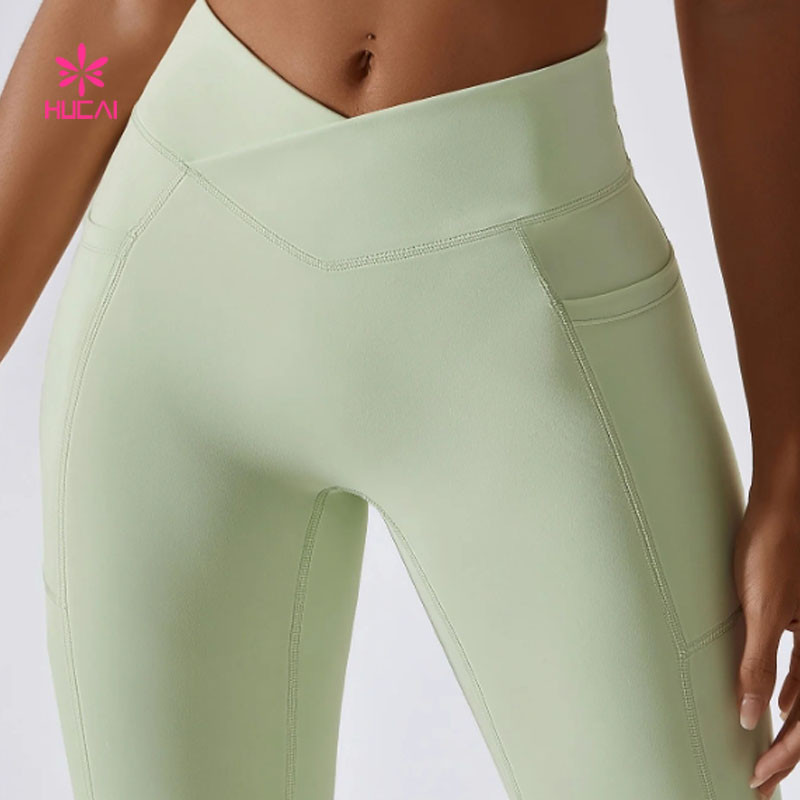
Where a scrunch is present, symmetry becomes the measurable failure. A centre-back gather is only as even as the tension on either side of it, and that tension is set by three things working together: the length of the gathered zone, the elastic recovery of the base fabric, and the seam that anchors the gather. If the fabric is cut slightly off-grain on one side, or the gathered length is even a few millimetres longer on one panel, the seat line will sit asymmetrically once the garment is worn, even though it looks acceptable flat. DFYNE's documentation of a firm scrunch alongside glute contouring and three leg lengths is a useful reminder that the gathered zone is intended to be deliberate and controlled rather than loose.
HUCAI Sportswear controls this by pairing the two back panels before stitching rather than cutting them independently, and by checking the gathered length against the pattern rather than against the previous panel. A V-shaped waistband seam is also worth specifying on the matching bra or top, because a set is judged as a set and an asymmetric centre back on the bottom is far more obvious when it sits directly below a symmetric top.
5. Validating the V Under Tension Before Bulk
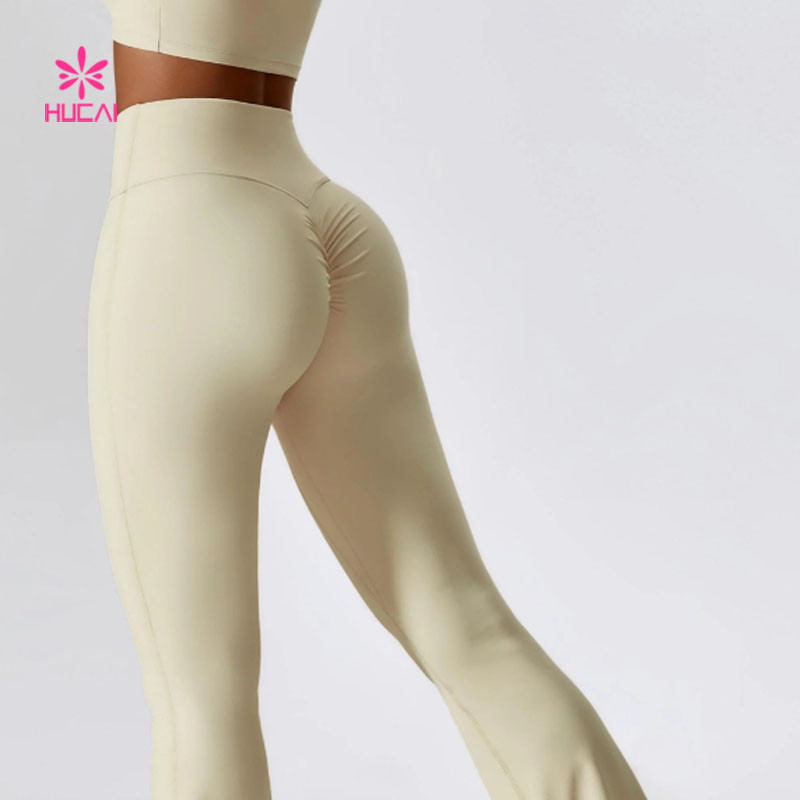
The last variable is state. A V-contour bottom is commonly approved on a flat sample, in a stationary position, under studio light. The customer experiences it stretched over a seat and under load, where a high-stretch knit darkens slightly, opens at the ribs or changes the visual depth of the seam. The observation is that a contour approved at rest is not yet approved. LSKD's no-front-seam construction puts the entire front of the legging under a single uninterrupted surface, which raises the standard for what the back has to deliver: with no front seam to break the line, any back-seam distortion is more exposed.
HUCAI Gymwear therefore validates contour styles in two states, relaxed and under tension, on a live fit body rather than a mannequin, and records both as the bulk reference. The same session also confirms opacity, because a deeper contour seam draws the eye to exactly the point where a thin fabric will show through. Where the brand is building on recycled polyester, the recycled fabric collection is usually the faster starting point, since the base has already been developed for recovery and opacity rather than being adapted afterwards.
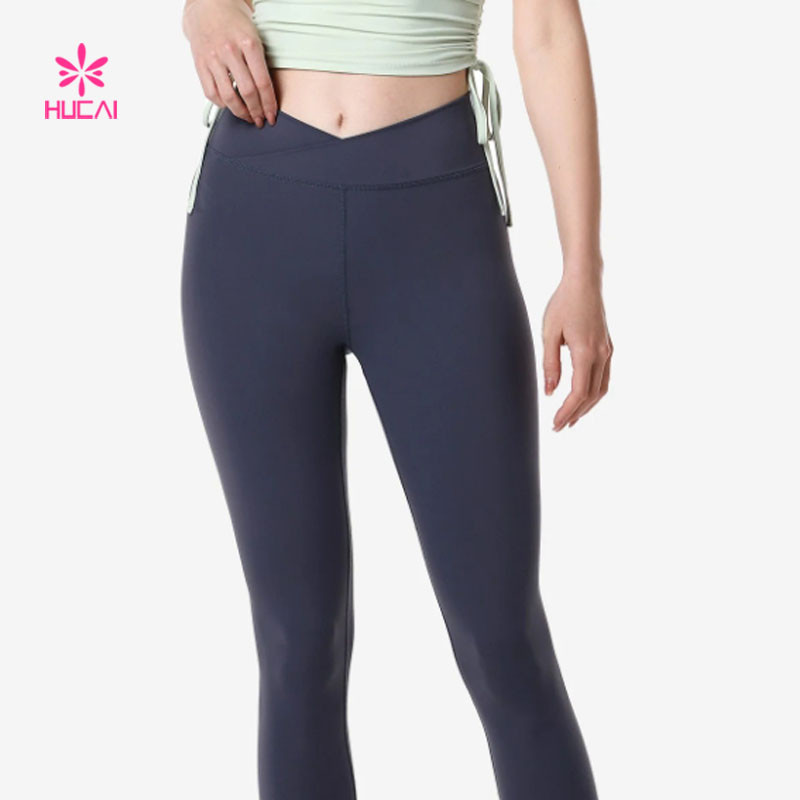
From Jean Yuan's product-development perspective, the mistake that reaches the sample room most often is treating a V-back as one pattern that simply gets bigger and smaller. A V is an angled line, and an angled line changes its apparent depth as the hip circumference grows, so a design approved on a base size can look shallow at XL and steep at XS even though nothing in the specification changed. For Jean, the working habit is to fix the angle after the graded pattern is cut rather than before, to pair the two back panels instead of cutting them separately, and to judge the contour on a fit body under tension, since a table tells you the seam is straight and nothing more.
6. Decision Check: Validation Points by Contour Route
Use the table below to decide which checks a contour style needs before a bulk date is fixed. The two routes share a base block in most programmes, so the practical question is which single check is most likely to catch a defect at the sample stage. Brands building a contour bottom usually start from the existing sculpting leggings range and adjust one variable at a time.
| Construction route | What creates the shaping | Fabric requirement | Pattern checkpoint before bulk | Failure signature to watch |
|---|---|---|---|---|
| Structural V-yoke, panel geometry | Position and angle of the back yoke seam, plus the depth of the panel above it | Stable recovery, medium to high gauge, opacity across the seat | Re-check yoke seam position and V angle at XS and XL after grading | V reads shallow on larger sizes, or the seam drifts off the seat apex |
| V-back with scrunch, gathered tension | Length of the gathered centre-back zone and the elastic recovery of the base | High-recovery knit with consistent grain direction on both back panels | Pair both back panels before stitching, and verify gathered length against the pattern | Left-right seat asymmetry, or contour lost after the first wash cycle |
| V-waistband extension onto a bra or top | Continuity of the waistband seam across the set | Same base family as the bottom so recovery behaviour matches | Confirm seam continuity with the bottom and top worn together | Set photographs as two unrelated pieces rather than one design language |
| Capri or short extension of a contour block | Same back-panel geometry carried onto a shorter inseam | Same recovery, re-verified at the shorter hem | Re-verify seat contour position and hem tension at the new length | Hem riding during movement, or contour shifting relative to the knee |
7. Questions US, AUS and Canadian Sourcing Teams Ask Most
What actually creates a subtle V-contour in a legging?
Either panel geometry or gathered tension, and the two behave differently. A structural V-yoke shapes through where the back seam sits and how the panel above it is cut, which is the approach used on the V-shaped waistband seam legging in our development range. A V-back with scrunch shapes by gathering the centre back and relying on fabric recovery. Subtle contouring generally comes from the first route, because gathered tension is harder to keep even.
Can a V-back be graded from one base size?
Not reliably. An angled seam does not scale in proportion the way a vertical one does, so a V graded from a single base tends to flatten on larger sizes and steepen on smaller ones. The angle and the seat position should be re-checked at the smallest and largest sizes after grading.
Why does a scrunch sometimes come out asymmetrical?
Because the gathered zone is only as even as the tension on either side of it. Off-grain cutting on one back panel, or a gathered length that differs by a few millimetres between panels, will show as an uneven seat line once worn even if the flat sample looks acceptable.
Should the same V-back be used on shorts and capris?
The design language can carry over, but the checks cannot. A shorter inseam changes hem tension and moves the contour position relative to the knee, so the seat contour and hem are re-verified at the new length. The same applies when a contour language is extended onto training shorts.
Does a deeper contour seam affect squat-proof opacity?
It can, because a contour seam draws attention to the exact area where a thin fabric shows through. That is why bottoms are checked against Grade 4 to 5 squat-proof opacity testing as part of the same production review rather than as a separate step.
What is the minimum order for a custom contour legging?
Flexible MOQ starts at 100 pcs per style and colour, with mixed sizing across XS to XL, and sample development is supported before the bulk commitment.
How long does development take, and what is needed to start?
Sampling runs 7 to 10 working days when the fabric is available, and bulk production runs 20 to 25 working days from pre-production sample approval and deposit receipt. To begin, a tech pack, a reference sample or a clear sketch plus the intended base fabric is enough to open a pattern.
Closing Summary
A V-contour legging is a pattern decision that shows up as a silhouette. Three choices carry most of the result: settle which route the style uses, because a structural yoke and a gathered scrunch need different fabric and different checks; re-verify the back-waist angle and seat position at the smallest and largest sizes instead of trusting proportional grading; and approve the contour on a fit body in both a relaxed and a stretched state, since a flat sample only confirms that a seam is straight. Where the contour is carried onto a set, the matching womens sports bra should be developed on the same base family so the recovery behaviour matches. Brands whose contour styles hold together across a size run are not choosing a more dramatic shape, they are validating it in a stricter order.
Dongguan Humen Hucai Garment Co., Ltd. Flexible MOQ from 100 pcs per style and colour. Sample development 7 to 10 working days. Bulk production 20 to 25 working days. 4-needle 6-thread flatlock stitching. AQL 2.5 inspection. Grade 4 to 5 squat-proof opacity testing on all bottoms.


